Welcome to the inaugural edition of the SDMX Newsletter — a new channel for sharing strategic developments, practical insights, and community achievements across the SDMX ecosystem.
Designed for both data producers and data users, this publication aims to keep the global SDMX community connected through concise updates on priorities, innovations, and implementation progress that support informed adoption and investment decisions.
In this first issue, we introduce the new SDMX identity, present the SDMX Vision Statement and Strategic Directions to 2030, highlight the revamped sdmx.org website, and share key developments in areas such as AI-readiness and central bank adoption, while also closing with a best-practice spotlight on the SDMx Lab as a practical space for experimentation.
SDMx rebranding: the new SDMx acronym
From eXchange standard to full statistical framework
Over the past twenty years, SDMX — originally known as Statistical Data and Metadata eXchange — has become the trusted global standard for official statistics. It now underpins data architecture, interoperability, quality management, regulatory reporting, semantic integration, and enterprise data governance.
Adopted by central banks, national statistical offices, international organisations, and financial regulators worldwide, SDMX has quietly become one of the most critical components of the world’s data infrastructure.
The SDMX Sponsors have announced a significant evolution in the name and positioning of the standard. SDMX will now be known as SDMx — the Standard for Data and Metadata.
For executive leadership, this evolution signals more than a rebrand. It affirms SDMx as a future-ready standard designed for modern data strategies, artificial intelligence, regulatory compliance, advanced analytics, and global data spaces.
Vision 2030: a roadmap for the future of SDMx
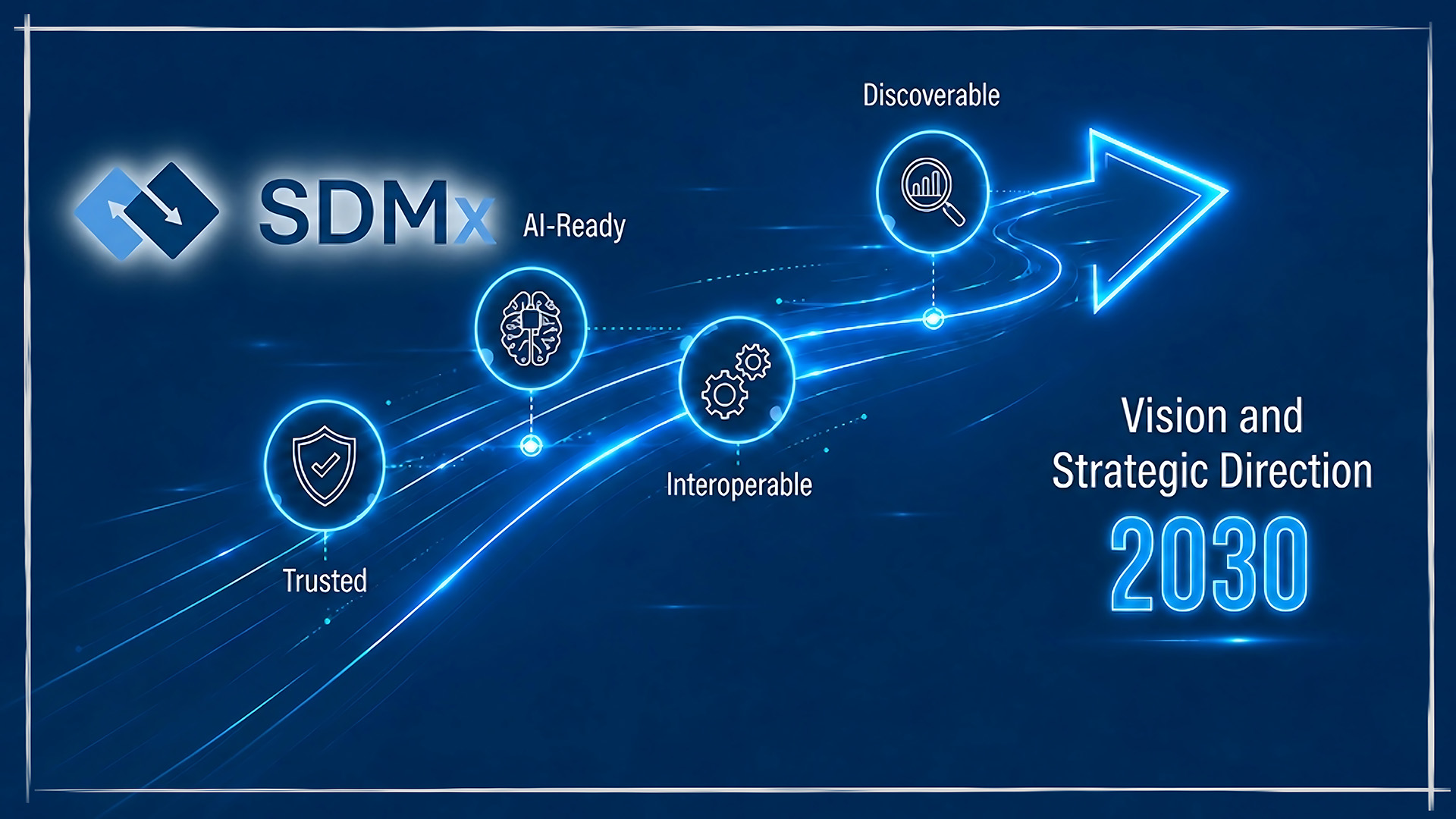
SDMx strategic direction 2030 and vision statement
The SDMx community has released its Vision Statement and Strategic Directions to 2030. This framework establishes a clear trajectory for the evolution of SDMx as a foundational standard for modern statistical systems.
The strategy is structured around four pillars — Trusted, AI-Ready, Interoperable, and Discoverable — and reinforced by three cross-cutting themes: Usable, Versatile, and Sustainable.
Together, these directions promote SDMx as a trusted, machine-readable foundation supporting the full statistical data lifecycle — from collection and production to dissemination and analysis.
Discover the new sdmx.org website
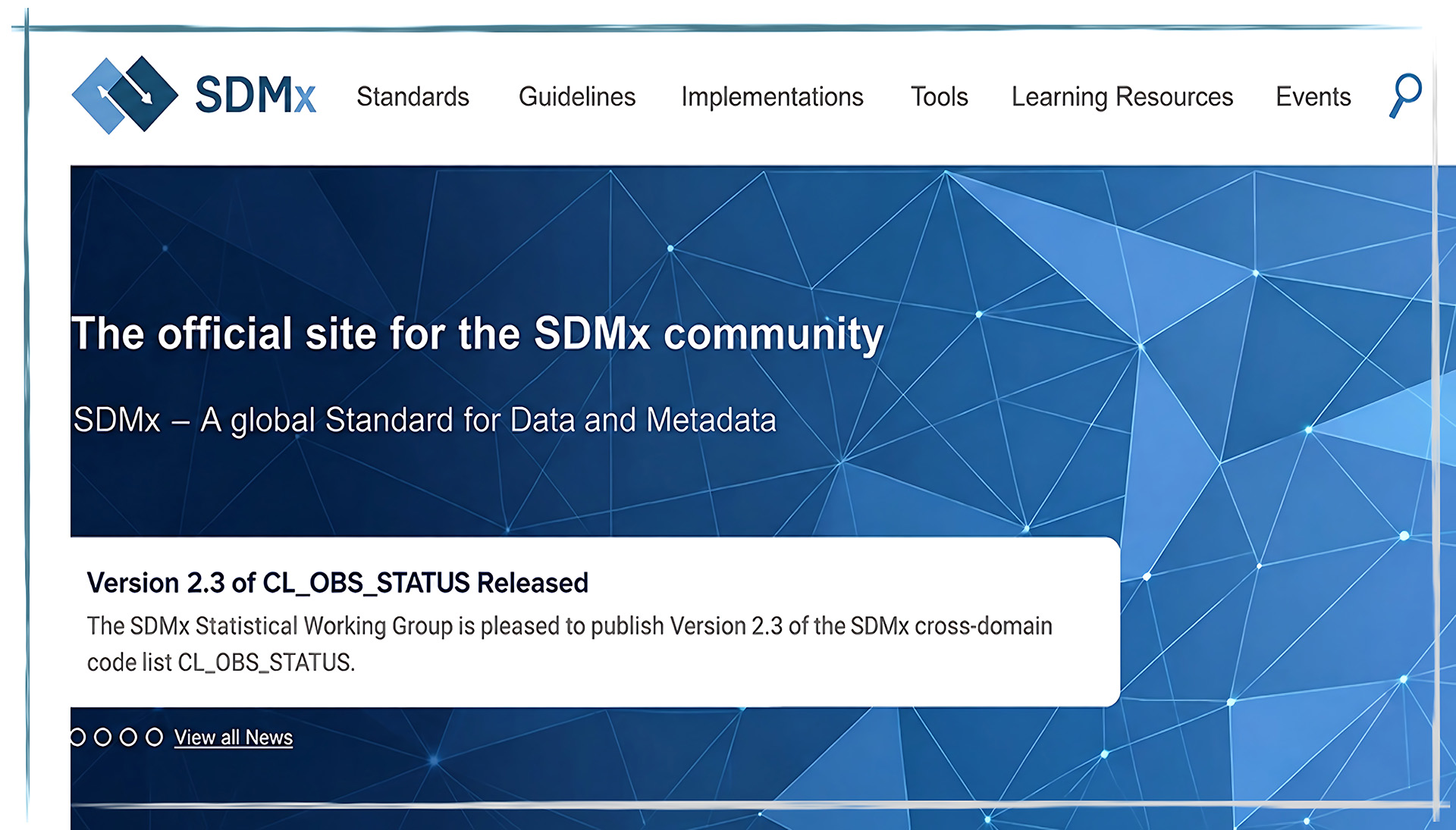
The new sdmx.org: clearer access to standards, tools, and learning resources
In line with the new SDMx branding, the sdmx.org website is undergoing a full refresh to better serve the global community with updated design, corporate identity, and enriched content from the different SDMx working groups.
Visit the revamped site to explore intuitive new rubrics: Standards, Guidelines, Implementations, Tools, Learning Resources, and Events — your gateway to continuous improvement and collaboration.
The Business Case for SDMx
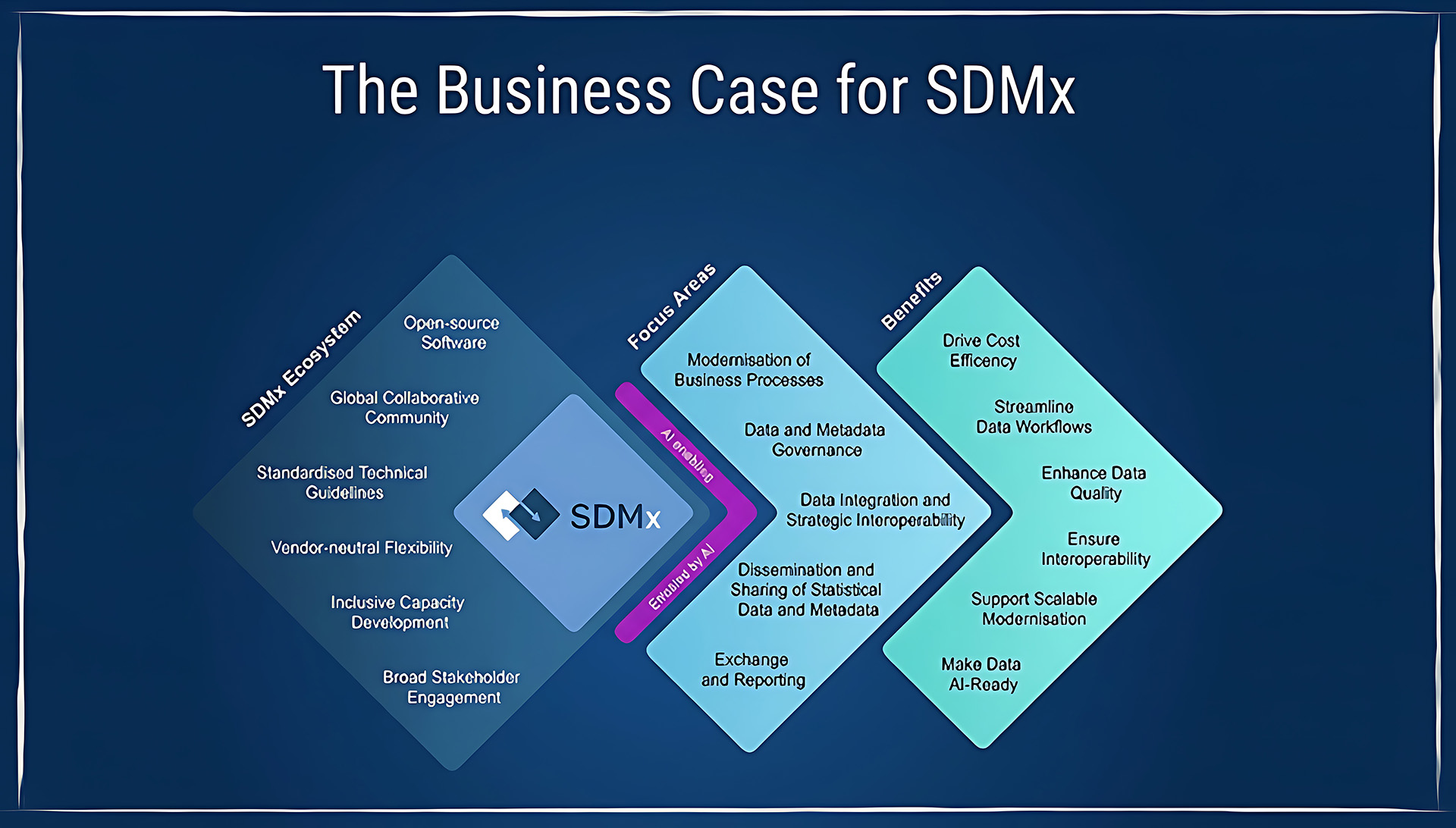
The SDMx Secretariat is pleased to introduce the SDMx Business Case, a resource designed to set out the practical value of SDMx for statistical organisations and other data producers. It shows how the standard can support a more coherent, efficient, and sustainable approach to managing data and metadata across the statistical value chain, while helping organisations align technology, governance, and business needs.
The document highlights five main areas where SDMx can deliver concrete benefits: modernisation of business processes, dissemination and sharing of statistical data and metadata, data and metadata governance, data integration and strategic interoperability, and exchange and reporting. It also underlines the growing relevance of artificial intelligence in official statistics, showing how SDMx can make data more structured, discoverable, and meaningful for AI applications, while AI can help accelerate SDMx implementation and improve the management of data and metadata.
AI-readiness: a joint commitment from SDMx sponsor organisations
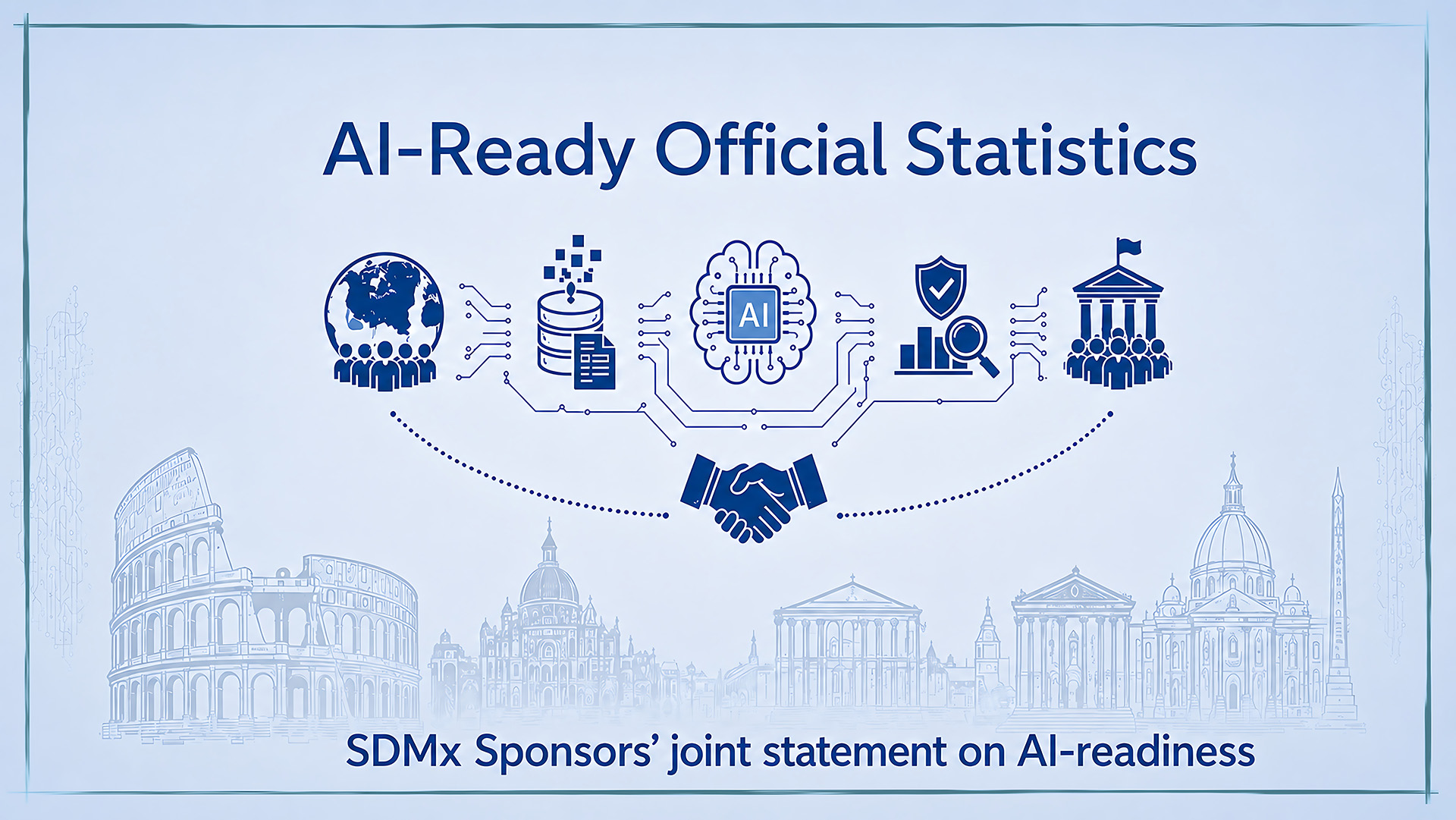
SDMx Sponsor organisations’ joint statement on AI-readiness
The SDMx community is pleased to welcome the joint statement on AI-readiness from its Sponsor organizations, following the 10th SDMx Global Conference held in Rome under the theme “Smarter Data for Better Insights.” The conference brought together the global statistical community, with AI-readiness emerging as a key focus.
The SDMx Sponsors have issued a joint statement on AI-readiness, recognizing that AI is reshaping how data are consumed and analyzed; statistical data must be machine-readable, well-structured, and trustworthy; and metadata quality is critical for interpretability and responsible AI use.
The Sponsors committed to pioneering technologies, governance, and tools for better metadata and interoperability, ensuring official statistics remain a reliable public good.
SDMx Adoption Accelerates Among Central Banks
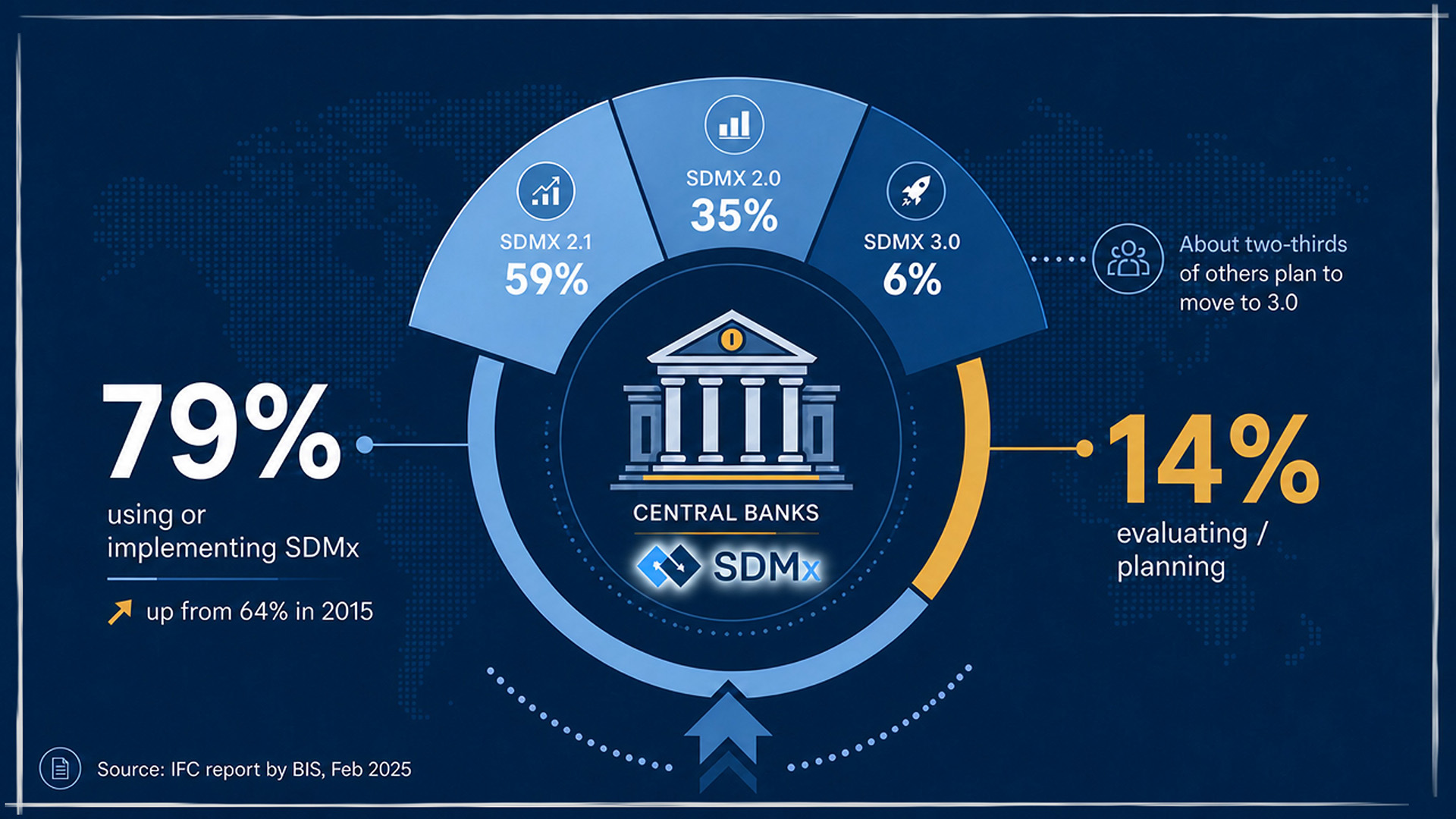
The latest BIS/IFC report from February 2025 surveys 52 central banks worldwide and reveals that 79% are now using or implementing SDMx, a notable increase from 64% in the 2015 survey. An additional 14% are evaluating or planning implementation, with dominant versions including SDMX 2.1 at 59%, 2.0 at 35%, and 3.0 at 6% — though around two-thirds of others plan to migrate to 3.0. Key barriers include adapting internal tools, resource shortages, and training gaps, while strongest adoption appears in domains like government finance, financial accounts, monetary and financial statistics, financial markets and securities, and balance of payments.
Trends show a shift beyond reporting (relevant to 81%) toward full lifecycle use, including production at 59%, high modeling and dissemination, and lower collection at 38%, with widespread open-source tool use but persistent gaps in VTL and XBRL conversion.
SDMx Lab: Lowering the entry barriers to SDMx
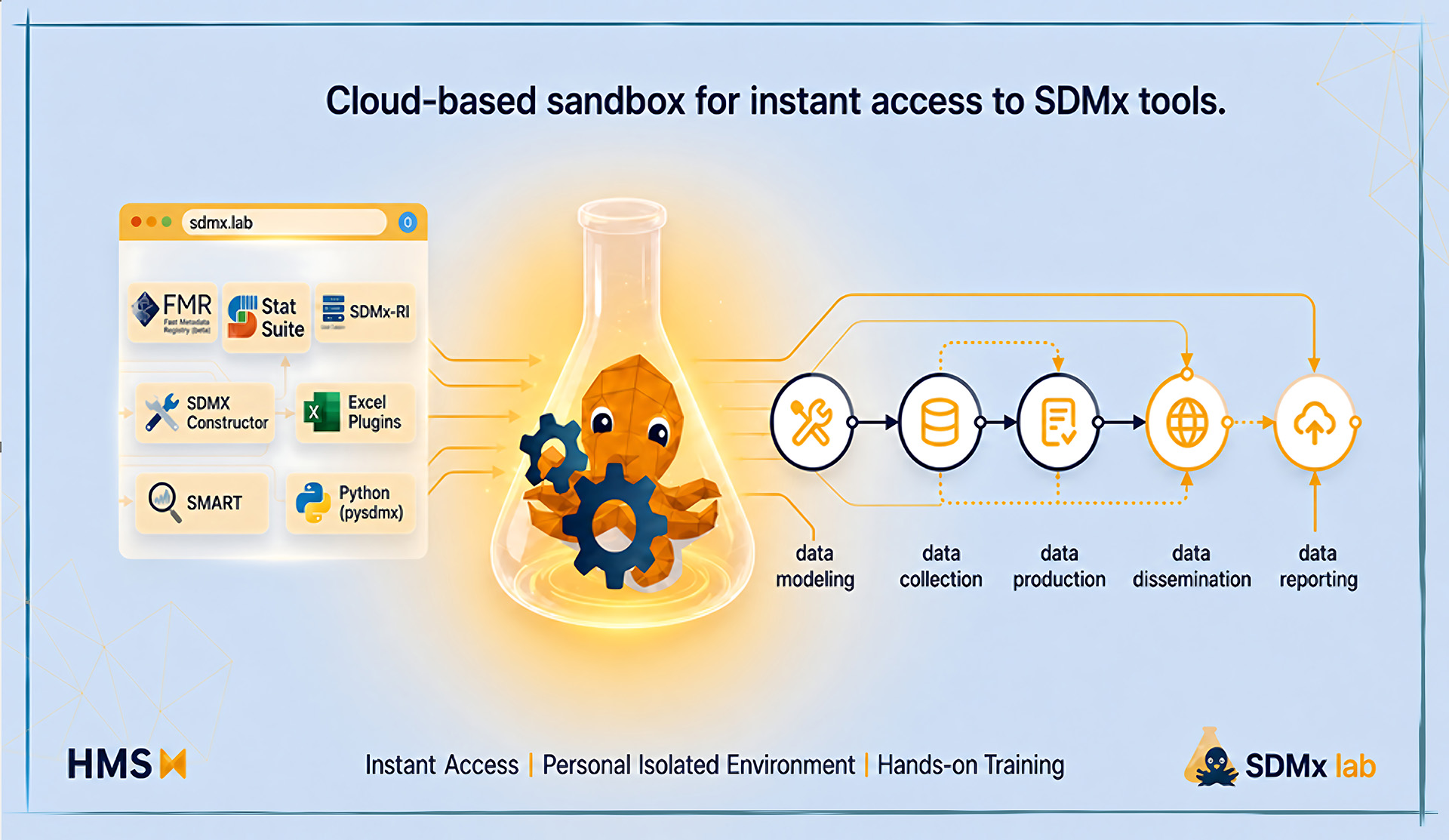
The SDMx Lab, introduced at the 2025 SDMx Global Conference in Rome, is a cloud-based sandbox that enables instant access to open-source SDMx tools directly through the browser — without requiring local installation or IT infrastructure. Each user receives a personal, isolated environment, making it ideal for hands-on training, self-learning, and proof-of-concept projects.
The platform integrates tools such as BIS Fusion Metadata Registry (FMR), OECD/SIS-CC .Stat Suite, Eurostat RI, Excel Plug-ins, and Python (pysdmx), along with a reset function for easy experimentation. Demonstrated to more than 250 conference participants, SDMx Lab was widely praised as a “game changer” for lowering the barrier to SDMx adoption. Future plans include expanded use in workshops, capacity building, and ongoing enhancements coordinated by BIS.